The Invisible Curator: How Recommendation Algorithms Are Silently Deciding What America Sees—and Why That Power Demands Accountability
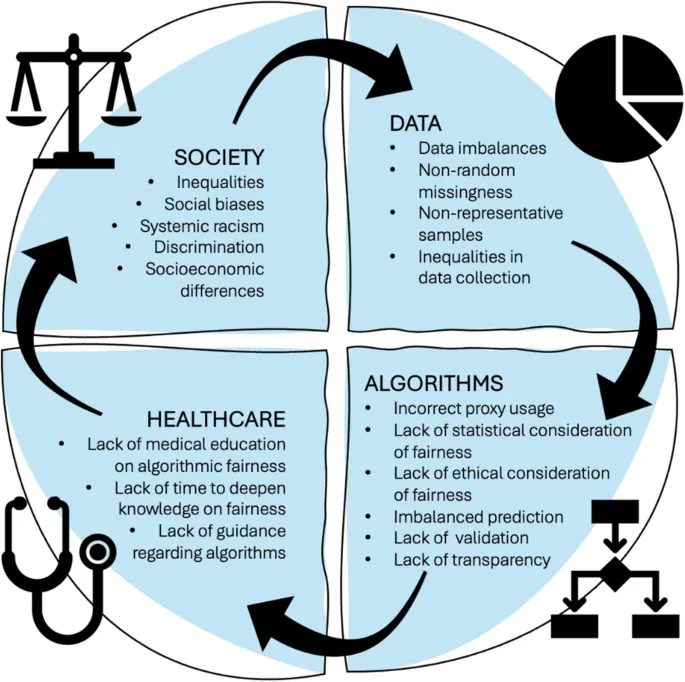
Photo: Chakradeo, K., Huynh, I., Balaganeshan, S.B. et al. Navigating fairness aspects of clinical prediction models. BMC Med 23, 567 (2025). https://doi.org/10.1186/s12916-025-04340-3, CC BY 4.0, via Wikimedia Commons
There is an editor working inside every American's phone. It decides which news stories feel urgent, which products appear affordable, which job listings seem worth applying for, and which political ideas seem broadly held. It operates at extraordinary speed, processes behavioral signals most users are unaware they are generating, and has no professional ethics board, no editorial standards policy, and no obligation to disclose its reasoning. It is the recommendation algorithm, and its influence on American information consumption has grown to a scale that most regulatory frameworks were never designed to address.
This is not a story about a single bad actor or a discrete technical failure. It is a story about infrastructure—the quiet, distributed, continuously learning systems that have become the primary intermediaries between information and the people who need it. And it is a story about what happens when that infrastructure reflects, and then amplifies, the inequities already present in the data it was trained on.
How Recommendation Systems Learn to Discriminate
To understand algorithmic bias, it helps to understand what recommendation systems are actually doing. At their core, these systems are pattern-recognition engines trained on historical behavioral data. A streaming platform's recommendation model learns that users who watched a particular documentary also tended to watch a second one. An e-commerce engine learns that customers who purchased one product category frequently returned for adjacent ones. A social media feed algorithm learns that certain content formats—emotionally charged, identity-affirming, outrage-inducing—generate more engagement signals than others.
The problem is not that these systems are learning. The problem is what they are learning from. Historical behavioral data is not neutral. It is a record of decisions made within social structures that have long encoded racial, economic, and gender disparities. When an algorithm trained on hiring platform data consistently ranks candidates from certain zip codes lower, it is not inventing a bias—it is inheriting one from the historical patterns in its training set and then institutionalizing it at scale.
Researchers at institutions including MIT and Carnegie Mellon have documented this inheritance across multiple domains. Facial recognition systems trained predominantly on lighter-skinned faces perform significantly worse on darker-skinned individuals. Mortgage recommendation tools trained on historical lending data have been found to route minority borrowers toward less favorable products. Healthcare algorithms that used cost as a proxy for medical need systematically underestimated the health burdens of Black patients, because historical spending disparities meant their needs had been consistently underfunded.
In each case, the system was doing exactly what it was designed to do. The design itself was the problem.
The Filter Bubble as Infrastructure Failure
Beyond individual discrimination, recommendation algorithms produce a second category of harm that operates at the societal level: the progressive narrowing of information exposure. The filter bubble—a term coined by internet activist Eli Pariser more than a decade ago—describes the phenomenon by which personalization systems gradually surround users with content that confirms existing beliefs while algorithmically deprioritizing material that challenges or complicates them.
The mechanism is straightforward. Engagement-optimizing algorithms learn that content aligned with a user's established preferences generates more clicks, longer watch times, and more shares. Presenting challenging or dissonant information produces friction—users scroll past it, close the tab, or actively signal displeasure. The algorithm interprets these signals as instructions and adjusts accordingly. Over time, the feed becomes a mirror rather than a window.
The political consequences of this dynamic have been documented across multiple election cycles. Research published following the 2016 and 2020 U.S. presidential elections found that social media recommendation systems contributed to asymmetric information environments in which different segments of the electorate were not merely disagreeing about policy—they were operating with fundamentally different sets of perceived facts. Platforms including Facebook and YouTube have acknowledged that their recommendation systems historically drove users toward increasingly extreme content, a byproduct of optimizing for the engagement that sensational material reliably generates.
This is not a partisan observation. The filter bubble dynamic has been documented across the political spectrum. It is a structural feature of engagement-maximizing recommendation design, not a reflection of any particular ideological intent.
Case Studies in Algorithmic Harm
The abstract becomes concrete quickly when examined through specific examples. In 2018, an investigation by journalists at The Markup found that Facebook's ad targeting tools allowed advertisers to exclude users from housing advertisements based on race, in apparent violation of the Fair Housing Act—a capability the platform had built and advertisers had used, despite existing civil rights law. The mechanism was not a deliberate policy of exclusion; it was a targeting system flexible enough to encode discriminatory preferences without explicitly labeling them as such.
On YouTube, internal research reportedly showed that the platform's recommendation engine was a significant driver of radicalization pathways—users who began watching mainstream political content were systematically recommended progressively more extreme material because that material generated higher engagement. The company made algorithmic adjustments beginning in 2019, but independent researchers noted that measuring the effectiveness of those changes was difficult precisely because the system's decision-making remained opaque.
In e-commerce, Amazon has faced repeated scrutiny over search ranking systems that appeared to favor the company's own private-label products in ways that were not disclosed to consumers. Pricing algorithms across platforms have been found to charge higher prices in ZIP codes with certain demographic profiles. Gig economy dispatch algorithms have been documented routing lower-paying assignments to drivers in specific geographic areas.
In each instance, the harm was real and measurable. The accountability was minimal.
What Transparency Actually Requires
The emerging consensus among technologists, civil society organizations, and a growing number of lawmakers is that algorithmic transparency must become a structural requirement rather than a voluntary disclosure. But transparency is a more complex demand than it initially appears.
Publishing an algorithm's source code, for instance, would satisfy a narrow definition of transparency while providing most affected users with no meaningful understanding of how decisions affecting them are made. What researchers and advocates are increasingly calling for is outcome transparency—regular, independently auditable reporting on the demographic distributions of algorithmic outputs across consequential domains including housing, employment, credit, and health.
Several legislative efforts at the federal level have begun to address this gap. The Algorithmic Accountability Act, introduced in multiple congressional sessions, would require companies above a certain size to conduct impact assessments for automated decision systems. The European Union's AI Act, which entered force in 2024, establishes risk-tiered requirements for algorithmic systems operating in high-stakes contexts—a framework that American regulators are watching closely.
On the technical side, the field of algorithmic auditing has matured considerably. Tools developed by researchers at institutions including Stanford and the AI Now Institute allow external analysts to probe the behavioral outputs of recommendation systems without requiring access to proprietary model weights. These audit methodologies are becoming a baseline expectation in policy conversations.
The Infrastructure Argument
The most compelling frame for this debate may not be technological at all. It is civic.
The United States has a long history of recognizing that certain infrastructure—roads, utilities, financial systems, broadcast media—requires public accountability precisely because its reach and influence are too consequential to be governed by market incentives alone. The editorial decisions of a newspaper with a circulation of fifty thousand were subject to public scrutiny in ways that a private conversation was not. The lending practices of a bank were subject to the Community Reinvestment Act because the consequences of those practices extended far beyond the bank's balance sheet.
Recommendation algorithms are now making editorial and economic decisions that affect hundreds of millions of Americans daily. The case for treating them as infrastructure—subject to transparency requirements, impact assessments, and meaningful accountability mechanisms—is not a radical proposition. It is an extension of principles the country has applied, imperfectly but deliberately, to powerful intermediaries throughout its history.
The question is not whether algorithmic systems will continue to shape what Americans see, buy, and believe. They will. The question is whether the public will have any meaningful say in the terms of that arrangement.