Cracking the Vault: How Quantum Computing Is Threatening Every Secret on the Internet—and the New Cryptography Built to Survive It
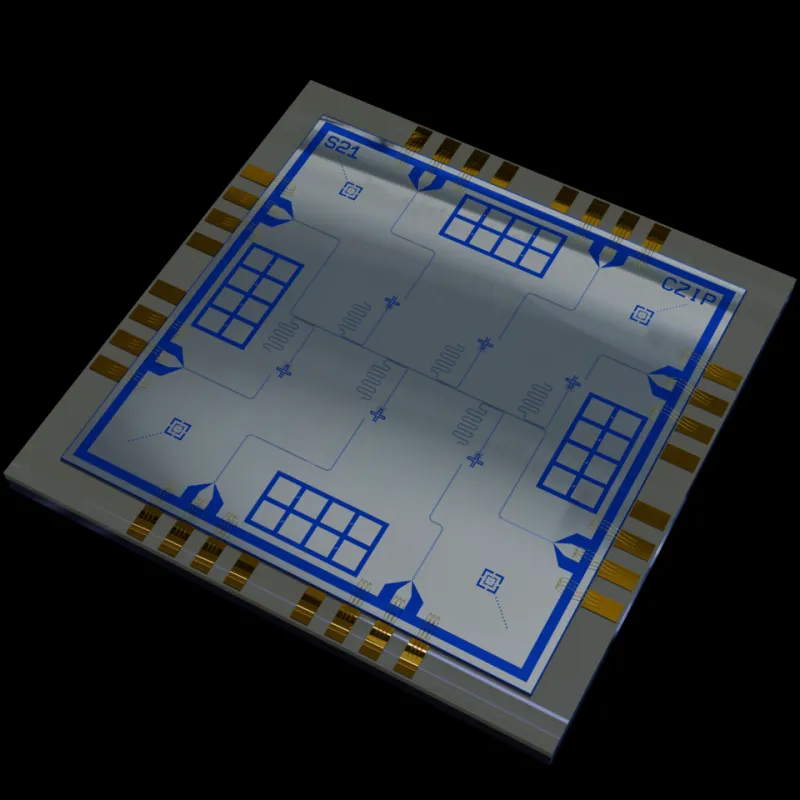
Photo: OJB Quantum, CC BY 4.0, via Wikimedia Commons
For most Americans, encryption is invisible infrastructure—the silent mechanism that turns a credit card number into an unreadable string of characters as it crosses the internet. It works so reliably, so quietly, that few people consider the possibility that it might one day fail. But within the cryptography community, that possibility has been a source of growing alarm for more than a decade. The concern is not a rogue hacker or a software flaw. It is physics.
Quantum computing, once confined to theoretical papers and government laboratory whiteboards, is maturing into a practical engineering discipline. And the computational principles that make quantum machines extraordinary also make them existentially dangerous to the encryption systems the modern internet depends upon.
The Mathematics That Keeps Secrets—and Its Vulnerability
The encryption protocols most widely used today—RSA, elliptic curve cryptography, and Diffie-Hellman key exchange—rest on a shared mathematical premise: certain calculations are trivially easy to perform in one direction and computationally prohibitive to reverse. Multiplying two large prime numbers together takes milliseconds. Factoring the resulting product back into its components would take a classical computer millions of years at sufficient key lengths.
Quantum computers do not play by those rules. An algorithm developed by mathematician Peter Shor in 1994 demonstrated that a sufficiently powerful quantum machine could factor large integers exponentially faster than any classical approach. At the time, the hardware to run Shor's algorithm at meaningful scale did not exist. Today, it still does not—but the gap is narrowing with notable speed.
IBM, Google, and a constellation of well-funded startups have each announced successive generations of quantum processors measured in qubits, the quantum analogue of classical computing bits. Google's 2019 claim of "quantum supremacy"—performing a specific task faster than any classical machine—was contested in its scope but broadly accepted as a milestone. More recently, IBM's roadmap has projected fault-tolerant quantum systems capable of running complex algorithms within this decade.
The cryptographic community's honest assessment is not that quantum computers will break the internet tomorrow. It is that they could break it within a window that is shorter than the time required to replace the encryption infrastructure already in place.
"Harvest Now, Decrypt Later": The Threat That Is Already Here
One of the more unsettling dimensions of this problem is that adversaries do not need a working cryptographic quantum computer today to begin exploiting the eventual capability. Intelligence agencies and sophisticated state actors are believed to be actively collecting encrypted communications now, storing them in anticipation of the day when sufficiently powerful quantum hardware arrives. This strategy—known within security circles as "harvest now, decrypt later"—means that data considered secure today may be retroactively exposed years from now.
For most consumer transactions, that window is irrelevant. For classified government communications, long-term financial records, sensitive medical data, or intellectual property with decades of value, the calculus is entirely different. The U.S. National Security Agency acknowledged this threat vector in guidance issued to national security system operators as early as 2015.
The geopolitical dimension compounds the urgency. China has made quantum computing a central pillar of its national technology strategy, investing an estimated $15 billion in quantum research infrastructure. The prospect of a major adversary achieving cryptographically relevant quantum capability before the United States completes its transition to quantum-resistant standards is not a hypothetical concern in Washington policy circles—it is a planning assumption.
NIST Steps In: Standardizing the Post-Quantum Future
The National Institute of Standards and Technology began its formal post-quantum cryptography standardization process in 2016, soliciting candidate algorithms from the global research community and subjecting them to years of rigorous public scrutiny. The process was deliberately transparent—an acknowledgment that cryptographic standards must withstand adversarial analysis from every direction.
In August 2024, NIST finalized its first set of post-quantum cryptographic standards. The primary algorithms selected include CRYSTALS-Kyber for key encapsulation and CRYSTALS-Dilithium for digital signatures, both based on the mathematical hardness of problems involving structured lattices—a class of geometry that resists both classical and quantum attack. A second algorithm, SPHINCS+, offers a hash-based signature scheme as an alternative construction.
These are not theoretical proposals. They are published standards with implementation guidelines, ready for integration into software libraries, operating systems, and hardware security modules. The NIST standardization is, in effect, the starting gun for a global migration effort.
The Migration Problem: Enormous, Expensive, and Unavoidable
Replacing cryptographic infrastructure is not analogous to pushing a software update. Encryption is woven into the fabric of every networked system—embedded in browsers, servers, IoT devices, payment terminals, industrial control systems, and telecommunications hardware spanning decades of deployment cycles. Some of that hardware cannot be updated remotely. Some of it cannot be updated at all.
Major technology companies have already begun the transition. Google has implemented hybrid post-quantum key exchange in Chrome and in internal communications. Apple introduced post-quantum cryptographic protections in iMessage with its PQ3 protocol in early 2024. Cloudflare, which handles a significant fraction of global internet traffic, has been running post-quantum experiments at scale since 2022.
For enterprise organizations and government agencies, the migration path is considerably more complex. The Cybersecurity and Infrastructure Security Agency has issued guidance urging federal agencies to complete cryptographic inventories—cataloguing every system that uses public-key cryptography—as a prerequisite for planning the transition. That inventory process alone is revealing the staggering breadth of the problem.
The financial sector faces particular exposure. Banking systems built on legacy infrastructure, some of it running decades-old code, will require substantial investment to migrate. The timeline pressure is real: analysts estimate that a full infrastructure transition, even with adequate funding and coordination, may take ten to fifteen years. That timeline and the projected quantum threat window are uncomfortably close.
A New Architecture for a Quantum-Aware World
Post-quantum cryptography is not the only defensive strategy under development. Quantum key distribution—a technique that uses the physical properties of quantum particles to exchange encryption keys in a way that is theoretically undetectable to eavesdroppers—is being piloted in fiber networks in several countries, including limited deployments in the United States. It represents a fundamentally different approach, using quantum physics as a shield rather than a sword.
The practical limitations of quantum key distribution are significant, however. It requires dedicated fiber infrastructure, has distance constraints, and does not yet scale to global internet deployment. For the foreseeable future, mathematical post-quantum algorithms represent the more viable path for the vast majority of applications.
What is becoming clear to the technology community is that cryptographic agility—the ability to swap out algorithms without rebuilding entire systems—must become a design requirement rather than an afterthought. Systems built today that cannot accommodate algorithm updates will become liabilities within the decade.
The transition to post-quantum cryptography will not be a single event. It will be a prolonged, expensive, and frequently unglamorous engineering effort conducted largely out of public view. But the alternative—arriving at a world with capable quantum computers and classical encryption still in place—is a risk that neither the private sector nor the federal government can reasonably accept. The vault must be rebuilt before the lock is picked.