The Authenticity Crisis: How AI-Generated Deception Is Reshaping Trust—and the Tools Pushing Back
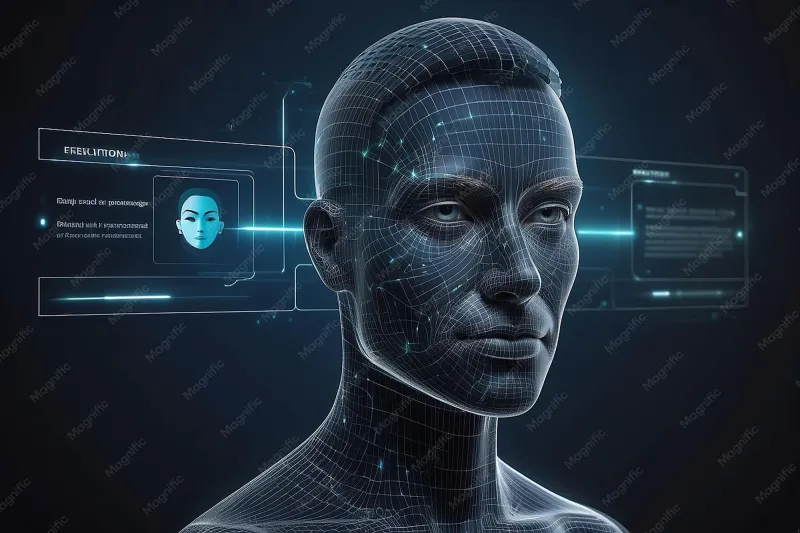
Photo: digital face recognition cybersecurity authentication technology, via img.freepik.com
There is a particular unease that settles in when you can no longer trust your own eyes. For most of human history, video and audio recordings functioned as reliable anchors of reality—imperfect, certainly, but fundamentally tied to events that actually occurred. That anchor is loosening. The synthetic media commonly called deepfakes have progressed from unconvincing novelties to outputs that routinely fool not only casual viewers but also journalists, security professionals, and automated screening systems. The societal infrastructure built on the assumption that seeing is believing is under sustained pressure, and the response from technologists, regulators, and media institutions is still taking shape.
From Research Lab to Widespread Deployment
The term deepfake entered public vocabulary around 2017, when generative adversarial networks—a class of AI architecture in which two neural networks compete to produce and evaluate synthetic outputs—were applied to face-swapping with results that startled the research community. Within a few years, the computational resources required to generate convincing synthetic video dropped from institutional to consumer grade. Today, open-source tools available to anyone with a standard laptop can produce face-swapped footage of reasonable quality in hours. Commercial platforms offer voice cloning from audio samples measured in seconds.
The 2024 election cycle in the United States offered a sobering demonstration of the technology's reach. Robocalls using a cloned voice resembling President Biden circulated in New Hampshire ahead of the primary, instructing registered Democrats not to vote. A synthetic audio clip purporting to feature a local police chief discouraging minority voter turnout spread across social media before fact-checkers could respond. Neither incident required sophisticated actors or significant funding. Both caused measurable confusion.
Beyond electoral interference, the financial sector has encountered deepfake fraud at scale. In one widely reported case, a finance employee at a multinational firm was deceived into transferring the equivalent of twenty-five million dollars after participating in a video call populated by AI-generated likenesses of colleagues and executives. The FBI has issued repeated advisories warning that synthetic media is being integrated into business email compromise schemes with increasing regularity.
The Detection Challenge
Countermeasures exist, but the field is engaged in an asymmetric contest. Detection systems trained to identify artifacts of synthetic generation—subtle inconsistencies in blinking patterns, lighting angles, skin texture, or audio spectral signatures—become obsolete as generative models improve. The dynamic is structurally similar to antivirus software racing against malware: each advance in detection incentivizes a corresponding refinement in generation.
Several research institutions and companies are pursuing detection approaches that attempt to move beyond artifact analysis. Intel's FakeCatcher system, for example, analyzes subtle changes in skin color caused by blood flow—a physiological signal that current generative models do not replicate accurately. Microsoft's Video Authenticator tool examines pixel-level inconsistencies at the boundary between a manipulated face and the surrounding frame. Startups including Sensity AI and Reality Defender are building enterprise-grade screening platforms that apply ensemble detection methods, combining multiple analytical signals to reduce false negative rates.
The fundamental limitation of all reactive detection is that it operates after the synthetic content has already been created and potentially distributed. A video that circulates for six hours before being flagged as fabricated may have already shaped the perceptions of millions of viewers. Research on corrective information consistently finds that retractions and fact-checks, while valuable, rarely achieve the same reach as the original misleading content.
Provenance as Infrastructure
A growing consensus among technologists and media organizations holds that detection alone is insufficient. The more durable solution lies in establishing cryptographic provenance—embedding verifiable records of origin and editing history directly into digital media at the point of capture.
The Coalition for Content Provenance and Authenticity, known as C2PA, has emerged as the primary standards body pursuing this approach. Its technical specification defines a method for attaching tamper-evident metadata to images, video, and audio files, recording the device that captured the content, the software that processed it, and any modifications applied along the way. The standard has received backing from Adobe, Microsoft, Sony, Nikon, and the BBC, among others. Adobe's Content Credentials feature, now integrated into Photoshop and Lightroom, allows creators to attach a verifiable identity and editing record to their work.
Camera manufacturers are beginning to implement C2PA signing at the hardware level, meaning that a photograph taken with a compatible device carries a cryptographic attestation from the moment of capture. This does not make fabrication impossible—a deepfake could be generated and then signed with fraudulent credentials—but it creates a chain of custody that makes tampering detectable and shifts the burden of proof in a useful direction.
Social media platforms present a more complex implementation challenge. Meta, YouTube, and X have each announced policies requiring disclosure of AI-generated content in certain categories, particularly political advertising, but enforcement mechanisms remain inconsistent and the definition of what constitutes AI generation is contested at the margins.
The Regulatory Dimension
Legislative responses in the United States are advancing, though unevenly. The NO FAKES Act, introduced in the Senate, would establish a federal right for individuals to control the use of their voice and likeness in AI-generated content. Several states, including California and Texas, have enacted laws specifically targeting deepfakes used for electoral interference or non-consensual intimate imagery. The Federal Communications Commission has ruled that AI-generated voices in robocalls are subject to existing restrictions under the Telephone Consumer Protection Act.
Critics of the current regulatory patchwork argue that jurisdiction-by-jurisdiction approaches create compliance complexity without establishing the national standards necessary to address a technology that operates across state and international lines simultaneously. The European Union's AI Act, which includes provisions specifically addressing synthetic media disclosure, is being watched closely by US policymakers as a potential template—though First Amendment considerations create meaningful constraints on how far content-based regulation can extend in the American context.
Rebuilding the Infrastructure of Trust
The deepfake challenge is, at its core, an infrastructure problem. The internet was not designed with authenticated identity or content provenance as foundational properties; those capabilities were assumed to be unnecessary or were deferred in favor of openness and speed. Correcting that architectural omission retroactively, across billions of devices and trillions of existing files, is an undertaking measured in decades rather than years.
What the current moment demands is a parallel investment in both technical standards and media literacy. Detection tools and provenance frameworks create the conditions for trustworthy digital communication, but they require users, institutions, and platforms to actively adopt and enforce them. A cryptographic certificate attached to a photograph means nothing if the viewer has no interface through which to interpret it.
The organizations and institutions that treat content authenticity as a genuine infrastructure investment—rather than a compliance checkbox—will be better positioned to maintain credibility as synthetic media becomes ubiquitous. In an environment where fabrication is trivially easy, the demonstrated commitment to verifiability becomes a form of competitive differentiation. Trust, once understood as a given, is becoming something that must be actively built and continuously maintained.