Living Light: How Bioluminescent Biology and Artificial Intelligence Are Rewriting the Future of Displays
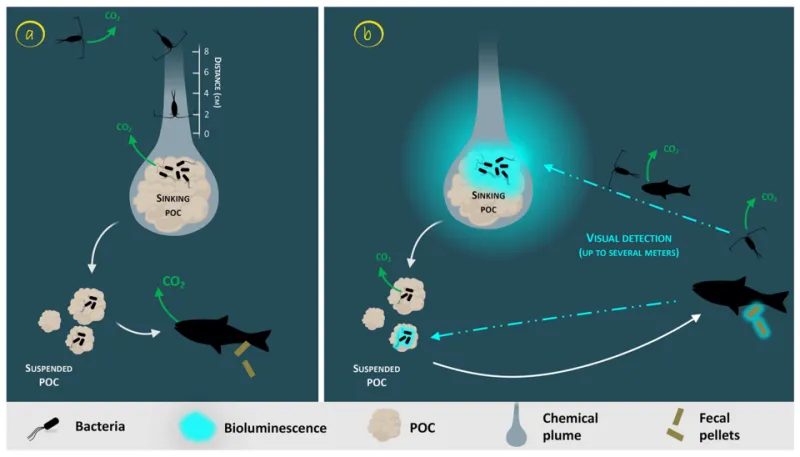
Photo: Lisa Tanet, Séverine Martini, Laurie Casalot and Christian Tamburini, CC BY-SA 4.0, via Wikimedia Commons
The firefly has no power cord. The deep-sea anglerfish requires no backlight. For hundreds of millions of years, evolution has been refining the art of producing visible light through chemistry alone — a process called bioluminescence that consumes a fraction of the energy required by any human-engineered illumination system. Today, that biological elegance is attracting serious scientific and commercial attention, as researchers explore whether the mechanisms that light up a jellyfish could one day illuminate a smartphone screen.
It is an idea that sits comfortably at the outer edge of plausibility — and that is precisely what makes it worth examining closely.
Nature's Blueprint for Cold Light
Bioluminescence operates through a deceptively simple chemical reaction. An enzyme called luciferase catalyzes the oxidation of a substrate — luciferin — in the presence of oxygen, releasing energy in the form of photons rather than heat. The result is what scientists call "cold light": highly efficient, thermally minimal, and produced entirely without electrical input.
The phenomenon is not rare. It appears in bacteria, fungi, marine invertebrates, fish, and insects across virtually every ecosystem on Earth. What varies dramatically between species is the color, intensity, duration, and control of the light produced. Some organisms, like certain dinoflagellates, emit light only in response to mechanical disturbance. Others, like the Hawaiian bobtail squid, maintain a symbiotic relationship with luminescent bacteria and modulate their glow with extraordinary precision.
For display engineers, these biological control mechanisms are as interesting as the light production itself. A screen that could dynamically adjust its output in response to contextual signals — ambient light levels, user interaction, software state — without drawing from a power source would represent a fundamental departure from every display paradigm currently on the market.
Where Synthetic Biology Meets Machine Intelligence
Translating bioluminescent function into manufacturable display technology requires solving several formidable problems simultaneously: sustaining living organisms or their biochemical components outside their native environments, engineering sufficient brightness and color range for practical use, and creating control systems capable of coordinating light output at pixel-level resolution.
This is where artificial intelligence enters the picture — not as a metaphor, but as a practical engineering tool.
Researchers at the University of California San Diego and MIT's Media Lab have been investigating computational approaches to modeling and optimizing luciferase variants. Machine learning algorithms trained on protein structure databases are being used to predict which genetic modifications might yield brighter, more stable, or differently colored bioluminescent output — a process that would take decades using conventional laboratory screening methods but can be accelerated dramatically through AI-assisted protein engineering.
"We're essentially using AI to explore an evolutionary design space that nature never had reason to visit," said one synthetic biologist involved in federally funded research on engineered bioluminescent systems, speaking at a conference on bio-integrated electronics held in San Francisco last year. "The organisms that exist today were optimized for survival, not for display resolution."
The implications extend beyond brightness. AI-driven control layers could theoretically manage populations of bioluminescent cells or biochemical substrates distributed across a display surface, modulating individual zones in response to image data — functioning, in essence, as a biological graphics processing unit.
Startups Staking Their Claims
The commercial landscape around bioluminescent display technology remains early-stage, but several US-based startups have begun staking out positions in what they believe will be a significant market by the early 2030s.
Glowbiotics, a company founded by former researchers from Johns Hopkins, is developing bio-integrated panels that use encapsulated luciferase systems — essentially the biochemical machinery of bioluminescence without living cells — to produce ambient lighting for architectural and retail applications. Their initial product targets sustainability-conscious commercial clients rather than consumer electronics, a deliberate strategy to generate revenue while the underlying technology matures.
Luminos Bio, headquartered in the Boston biotech corridor, is pursuing a more ambitious path: wearable displays embedded with engineered microorganisms capable of producing programmable light patterns on flexible substrates. The company has received seed funding from a consortium that includes a major consumer electronics manufacturer, though the identity of that partner has not been publicly disclosed.
A third entrant, Photon Living, is taking a hybrid approach — combining conventional microLED infrastructure with bioluminescent accent layers to reduce overall power consumption in next-generation smartwatch and fitness tracker displays. Their argument is not that bioluminescence will replace existing display technology outright, but that it can serve as an energy-harvesting complement, reducing battery drain during low-intensity display states.
The Wearable Frontier
Wearable technology represents perhaps the most immediately compelling application space for bioluminescent display research, for reasons that go beyond aesthetics. Battery life remains the defining constraint of the wearable device market. Any technology capable of meaningfully reducing display power consumption — which typically accounts for 30 to 50 percent of a smartwatch's energy budget — would carry significant commercial value.
Beyond efficiency, there is a tactile and experiential dimension to living light that purely electronic displays cannot replicate. Designers working at the intersection of fashion technology and biotech have begun exploring garments and accessories that incorporate bioluminescent elements, not as gimmicks, but as dynamic, responsive materials that change with their wearer and environment.
The broader cultural appetite for technology that feels more organic, more attuned to the natural world, is a trend that market researchers at Forrester and Gartner have both flagged as increasingly relevant to US consumer behavior — particularly among younger demographics who have grown up with both the promise and the environmental costs of conventional electronics.
Timelines, Obstacles, and Honest Uncertainty
Commercial viability for bioluminescent display technology in mainstream US markets remains a matter of genuine scientific and business uncertainty. The challenges are substantial: biochemical substrate depletion, the complexity of maintaining biological components within manufactured devices, regulatory pathways for products containing engineered organisms, and the considerable gap between laboratory demonstrations and mass production are all formidable barriers.
Most researchers active in the field offer cautious timelines. Niche architectural and wearable applications using encapsulated biochemical systems — rather than living organisms — could plausibly reach limited commercial availability within five to seven years. Full-color, high-resolution consumer displays based on bioluminescent principles are more likely a 2035 to 2040 proposition, if the fundamental scientific challenges yield to current research efforts.
What is not in question is the direction of intellectual energy. The convergence of synthetic biology, AI-assisted protein engineering, and an industry-wide push for more sustainable device manufacturing has created conditions in which bioluminescent display research is attracting talent and capital at a rate that would have seemed implausible a decade ago.
A New Kind of Screen
There is something philosophically resonant about the idea of displays that generate their own light — that draw from chemistry rather than circuitry, that blur the boundary between the manufactured and the living. Whether or not bioluminescent technology achieves mainstream commercial scale within the next decade, its development is already expanding the conceptual vocabulary of what a screen can be.
In a technology landscape often defined by incremental refinement, the researchers working at this frontier are asking genuinely different questions. The answers, when they come, may illuminate far more than a display surface.