The Quiet Luxury of Doing One Thing: Why the Dumbest Phone in the Room Is Winning Over America's Most Productive People
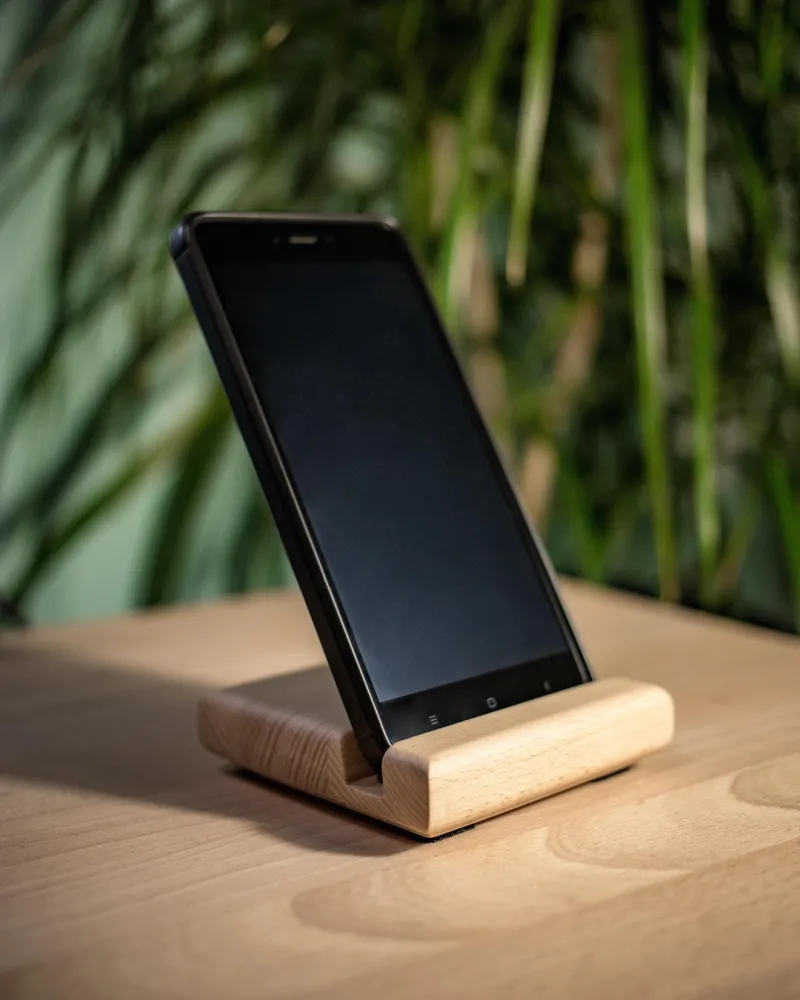
Photo: minimalist brick cell phone on wooden desk with notebook, via i.etsystatic.com
There is a peculiar scene playing out in coffee shops from Seattle to Brooklyn: a professional at work behind a laptop worth three thousand dollars, next to a phone that can do almost none of it. The device is chunky, e-ink in places, and its most celebrated feature is what it refuses to do. No infinite scroll. No red badges. No feed.
This is not a Luddite's protest. It may be the most commercially interesting signal in consumer technology right now.
The Subtraction Economy
For two decades, the smartphone industry has competed on a single axis: more. More cameras, more screen, more processing power, more of your day. That axis is exhausted. Upgrade cycles have stretched to nearly three years as the marginal gains have become invisible to ordinary users. When the additive frontier closes, companies face a choice — or a customer does.
A cluster of American startups has chosen subtraction. Devices like the Light Phone, the minimalist e-ink handsets from a New York company, and a wave of deliberate-communication gadgets have built businesses on a radical premise: the feature is the product. Their pitch is not what the phone does, but what it makes unnecessary.
The market has noticed. The dumbphone category, written off a decade ago, has grown steadily among a demographic nobody predicted: high-earning knowledge workers, physicians, attorneys, and founders — people whose attention is, by their own accounting, their most valuable asset.
What the Revival Is Really About
Skeptics frame the trend as digital detox theater, and some of it surely is. But the professionals adopting these devices describe something more practical than purity. They describe the recovery of contiguous time.
The modern smartphone is not a tool; it is an environment, and environments shape behavior. Research on task-switching has repeatedly shown that each interruption carries a re-focusing cost that outlasts the interruption itself. A device engineered to interrupt is not neutral — it is an instrument optimized against deep work, and its owners know it.
What makes the dumbphone revival durable, rather than a fad, is that its adopters are not rejecting technology. They are rejecting a particular business model — one in which the user's attention is the merchandise. A phone that cannot host an attention market has no incentive to capture you. That structural difference, not nostalgia for 2004, is the product.
The Status Symbol Inversion
There is also a social dimension worth naming. In an era when everyone carries the same slab of glass, the visible marker of sophistication is shifting. The person with a $100 handset and a $3,000 laptop is making a legible statement: my attention is allocated deliberately.
Luxury has always followed scarcity, and attention is now the scarcest commodity in professional America. Expect the market to respond accordingly. The first wave of minimalist devices was crude; the next wave will be refined — beautiful hardware, excellent calling and messaging, e-ink displays gentle on the eyes, and nothing else. The constraint will be the craft.
The Limits of Less
Honesty requires acknowledging the friction. Two-factor authentication, ride-hailing, mobile boarding passes, and maps are woven into American life, and a featureless phone makes them awkward. Most converts run a two-device strategy — a dumbphone daily and a smartphone in a drawer, deployed like a fire extinguisher. That is not a contradiction; it is the point. The smartphone becomes a tool you own rather than an environment that owns you.
Critics also note that minimalist devices remain niche-priced, often costing as much as mid-tier smartphones for radically less capability. The premium, defenders argue, is not for the hardware but for the absence — and absence, it turns out, has genuine market value.
The Larger Lesson
The dumbphone revival matters beyond its market size because it points at a broader truth about the next decade of technology. The great innovations of the last era were additive — capabilities stacked on capabilities until the device became a casino. The innovations of the coming era may be subtractive: interfaces that close, systems that end, products measured not by engagement but by how quickly they return you to your life.
The most disruptive feature of 2025 is not anything a device can do. It is everything it declines to. In a market that has spent twenty years shouting, the quietest product in the room is finally being heard.